By Morgan Eberhard, Principal Scientist
November 12th, 2026
By Morgan Eberhard, Principal Scientist
November 12th, 2026
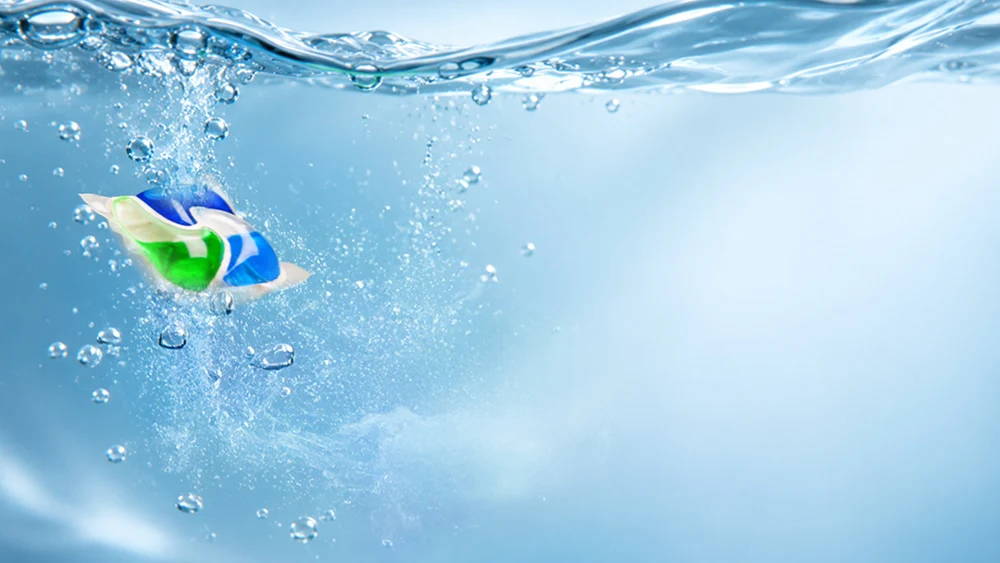
False: Dishwasher pods leave behind plastic on your dishes.
Truth: Wirecutter found little credible scientific evidence that dishwasher pods create or leave microplastics, or even nanoplastics, in your dishwasher or in waterways.
False: The main ingredient in dishwasher pod film, polyvinyl alcohol (PVA/PVOH), behaves like a traditional plastic, which breaks into particles called microplastics.
Truth: Wirecutter found that while detergent-grade PVA/PVOH shares some characteristics with durable plastics when dry, its environmental behavior once it’s dissolved in the dishwasher is distinctly different.
False: PVA/PHOV is technically a “plastic,” so it must contribute to microplastics.
Truth: Wirecutter’s research found that PVA in dishwasher pods dissolves into smaller, water-soluble molecules that experts say are capable of being broken down by microorganisms in the right environment, like the kind found in wastewater treatment plants.
Cascade’s own research has found that there is overwhelming scientific evidence that Cascade film does not create microplastics.
For a deep, independent analysis, see Wirecutter’s full article on the topic.
Pods feel like plastic—they’re sticky when wet and have a texture similar to plastic wrap. And technically, before use, the film does meet the definition of a plastic. For decades, this hasn’t been a concern because the consensus of the scientific community has been that the special type of plastic that dishwasher pod film is made from—polyvinyl alcohol or PVA/PVOH—is both safe and water-soluble. But lately, as Wirecutter notes, certain segments of the cleaning industry have launched marketing campaigns that portray dishwasher pods as microplastic pollutants. This content is understandably concerning, but it’s important to understand the distinctive properties of PVA/PVOH.
You can learn more about Cascade’s PVA/PVOH water-soluble smart film and how it was designed here.
Wirecutter’s reporting—based on years of interviews with chemists, toxicologists, environmental scientists, wastewater experts, and detergent manufacturers – found that regulators have considered that the PVA/PVOH used in dishwasher pods is safe for people to use. PVA/PVOH dissolves into smaller molecules, and multiple regulatory agencies—the EPA, FDA, and the European Food Safety Authority—deem it safe. Even attempts to detect PVA in waterways have yielded no measurable traces, according to scientists interviewed by Wirecutter. The widely circulated claim that “77 percent of PVA/PVOH remains in waterways” is based on modeling, not real-world conditions, and has received pushback by regulatory agencies and an independent panel of experts called SciPinion. In short, the Wirecutter article states that the scientific consensus still holds: the PVA/PVOH film in dishwasher pods does not behave like microplastics.
Cascade’s priority is, and always has been, clean dishes, safe products that support your well-being, and responsible practices. Part of that commitment includes answering your questions and concerns openly and using the best available science to guide our formulations. As misinformation about “plastic in dishwasher pods” continues to spread on social media, it’s even more important for us to clarify what’s real and what isn’t. Wirecutter’s independent reporting offers exactly the kind of rigorous and balanced review that this topic deserves. And their conclusion aligns with what decades of regulatory approval and internal review here at Cascade have shown about the safety of PVA/PVOH film in dishwasher pods.
Read on for a broader look at our environmental commitments.
It’s the question consumers ask most often: where does the film go? During the dishwasher cycle, the film rapidly dissolves in the hot water, exactly as it’s designed to do, releasing the detergent to get your dishes clean. As the film dissolves, the PVA/PVOH disperses into individual molecules (not particles). The dissolved material leaves your home, through the waste pipes, along with the dirty wash water, to a wastewater treatment plant, where the PVA/PVOH from the film is further degraded by microorganisms that feed on it. The scientists interviewed by Wirecutter emphasized that efforts to detect PVA/PVOH in real-world water systems have failed to find measurable levels. It doesn’t stick around in the water system or on your dishes, and it doesn’t make its way into your body.
If you want to dig deeper into the science, interviews, and research behind all of this, we encourage you to read Wirecutter’s full investigation: “Yes, Detergent Pods are Plastic. No, You Shouldn’t Worry.”